Why your next customer is probably already in your LinkedIn network
Most teams assume pipeline problems come from a lack of reach.
Not enough prospects.
Not enough outbound.
Not enough campaigns running.
So the default move is always the same.
Add more.
More tools.
More lists.
More outreach.
But there is a quieter issue hiding underneath all of that.
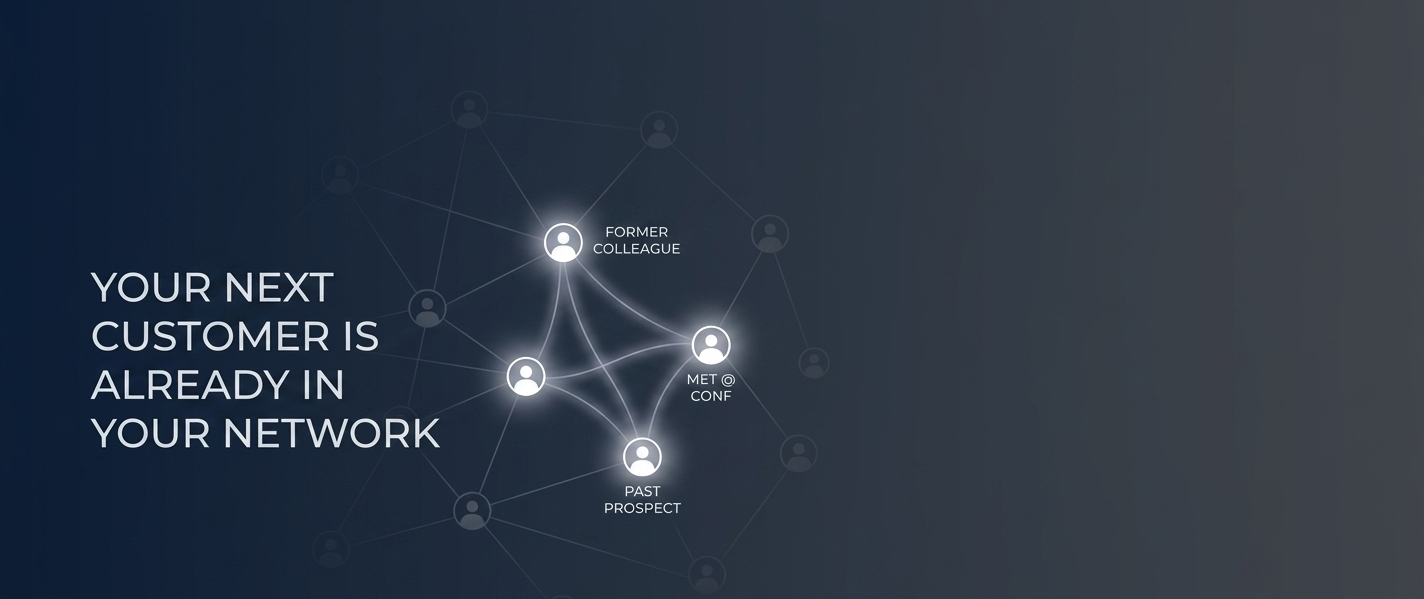
Your next customer is probably not outside your network.
They are already inside it.
You just are not looking at it that way.
Your LinkedIn network is not a list of connections
Most people treat LinkedIn like a static database.
A collection of names.
A place where connections go after a meeting or a message.
But that is not what it actually is.
Your network is a record of relationships that have already happened.
Inside it, you will find:
People you once pitched
Conversations that went cold
Customers who stopped at one deal
Colleagues who moved companies
Referrals that never turned into action
None of these are new leads.
They are existing relationships with different timing.
And timing is often the only thing that changed.
Past prospects are not lost
A common assumption in sales is that a “no” is final.
But in reality, most “no”s are just:
not now
not a priority
not the right timing
not enough context yet
A prospect who ignored you last year may now:
have budget
have a new role
be dealing with a new problem
be working under new leadership
The conversation did not end.
It just paused.
The challenge is that most teams never return to it.
Not because it is unimportant.
Because it is invisible.
Ex-customers are the most overlooked growth channel
Most companies think about customers in two stages:
Active
Churned
But the reality is more dynamic.
Ex-customers often become:
buyers at a new company
decision makers elsewhere
referral sources
reactivation opportunities
The mistake is treating them as “done.”
When in fact, they are often your warmest future pipeline.
You already earned trust once.
That does not disappear. It just goes dormant.
Ex-colleagues carry more leverage than you think
Most LinkedIn networks are built over years of working, switching jobs, and moving companies.
Ex-colleagues often:
move into leadership roles
change industries
build new teams
become buyers instead of peers
But in many cases, they stay mentally categorized as “old coworkers.”
Not decision makers.
Not partners.
Not opportunities.
That label never gets updated, even when their role does.
So the relationship stays frozen in time, even though their career does not.
Dormant referrals are already warm introductions
Referrals are usually treated as one-time events.
Someone introduces you.
A conversation happens.
Nothing moves forward.
Then it stops there.
But referrals rarely disappear.
They just lose attention.
That same person may still:
know your work
trust the original referrer
remember your conversation
be open to a different angle now
But without visibility, they never re-enter your pipeline.
The real problem is not reach. It is visibility
This is the core issue most teams miss.
It is not that they do not have enough people to talk to.
It is that they cannot see who is already there.
LinkedIn networks are full of signal:
past intent
prior conversations
shared history
timing shifts
role changes
But most of that signal is never surfaced.
So teams default back to outbound.
Not because it is better.
Because it is visible.
Opportunity discovery before prospecting
Most sales systems start with prospecting.
Find new leads.
Build new lists.
Start new conversations.
But there is another layer that comes first.
Opportunity discovery.
Looking at:
who already knows you
who already engaged before
who has changed context
who might be ready now
When you do that well, prospecting changes shape.
It becomes less about finding strangers.
And more about revisiting relationships at the right time.
This is why we built Aizyn
Aizyn exists because of a simple observation:
Most companies are sitting on more opportunity than they realize.
Not in theory.
In their actual LinkedIn network.
The problem is not lack of relationships.
It is the inability to see them clearly.
We help teams understand:
who in their network could become a customer
who is worth reconnecting with
where timing has changed
where opportunity already exists
Before they go looking for new ones.
Closing thought
If pipeline feels harder than it should be, it is worth asking a different question.
Not “How do we reach more people?”
But:
Who do we already know that we have stopped seeing clearly?
Because in many cases, your next customer is not new.
They are already there.
Just not visible yet.