Your LinkedIn Network Is a Gold Mine
You already own the claim. You've just never mined it.
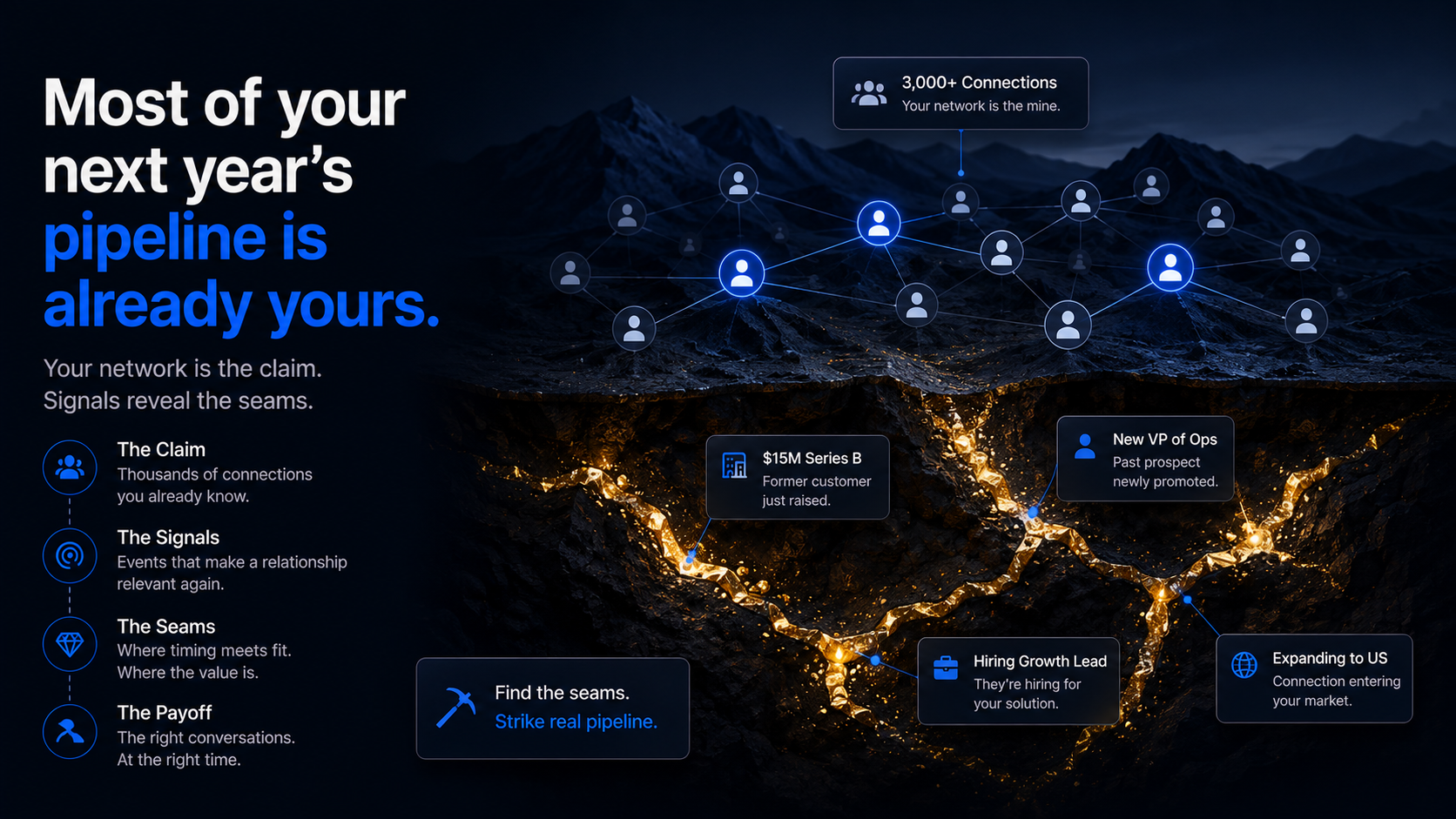
Somewhere in your LinkedIn network is most of your next year's pipeline.
Not in a list you haven't bought yet. Not in a market you haven't entered. In the connections already sitting in your account, most of which you haven't thought about in months.
This is an uncomfortable idea, because it means the problem was never a shortage. You have thousands of connections. People who took your call, bought from you once, shared an investor, sat next to you at a dinner and meant to follow up. Every one of them is a relationship you already spent years earning.
That is a claim you own outright. And like most claims, it doesn't look like wealth, because raw ground never does.
Why it doesn't feel like money
Gold isn't lying on the surface. If it were, someone would have already taken it.
It's buried, spread thin, and most of the claim is ordinary rock. Standing on it, you feel no richer than you did before. So it's easy to conclude there's nothing there and go looking somewhere else.
That is exactly what most people do. They leave the claim they own and go pan the same crowded river as everyone else: cold lists, cold outreach, strangers who have to be convinced you're worth a reply. It feels like progress because it's motion. It rarely is.
Meanwhile the ground under their feet goes untouched, not because it's empty, but because they have no way to see where the gold actually is.
The question was never "more people"
Here is the shift, and it's a small one that changes everything.
The question is not how to meet more people. You already know more than you can act on. The question is which of the people you already know is worth your attention today.
Those are completely different questions, and the second one is the only one that pays.
Because a relationship isn't valuable in the abstract. It becomes valuable at a moment. The former customer who churned on price is just a memory until their new round closes. The prospect who went quiet is inert until they start hiring for the exact problem you solve. The connection you forgot about is nothing until they step into a bigger role at a company in your market.
The seams
Those moments have a name. They are signals: external events that make a dormant relationship suddenly relevant.
A round closes. Someone moves into a senior role. A company announces it's expanding into a new category. Each one is a seam running through your claim, and it marks where the gold is this particular week.
The signal is the event. The person that event just made relevant is the opportunity. Keeping those two straight matters, because it's the reason "who has funding" is the wrong question and "who in my network just raised" is the right one. The money is not the opportunity. The relationship the money reactivated is.
Fool's gold
Not everything that glitters is worth digging for, and this is where most reactivation advice falls apart.
A funding round at a company that will never buy from you is fool's gold. It shines, it's tempting, and it's a waste of a morning. A senior hire at an account outside your ideal customer profile is the same. The event is real. The relevance to you is zero.
A seam is only worth working when the signal lands on someone who actually fits. Timing without fit is a distraction dressed up as an opportunity. This is why raw signal feeds don't help much on their own. They surface every glint, and leave you to sort the gold from the pyrite by hand.
Why nobody digs
If the gold is right there, why doesn't everyone mine it?
Arithmetic.
Say you have three thousand connections. To know which are worth a message today, you'd have to check each one for a recent change, then check whether that change actually matters given who you sell to, and then do it again next week, because a seam that hasn't opened yet this month may open next month.
Call it a few minutes per person, repeated. Across the whole claim, that's hundreds of hours a year of pure surveying, before you write a single message.
Nobody has hundreds of hours for surveying. So they sample. They work the twenty names they happen to remember and leave the other two thousand nine hundred and eighty in the ground. The size of your claim stops mattering the moment you can only inspect a corner of it.
That is the real reason the mine sits idle. Not laziness, and not a lack of relationships. A retrieval problem. The gold is there and you simply cannot find it fast enough to act while it's still worth acting on.
The assay
There's one more step between finding a seam and striking it, and it's the one that separates a good reconnect from an obvious one.
When you reach out, the person has to feel that you remember them, not that they came up on a list. That means leading with the specific: the thing you talked about last time, the reason this week is the right week, the change that made you think of them. One sentence of real memory beats ten of "just checking in."
The gold isn't only knowing who to dig for. It's knowing enough about why to open the conversation like someone who was paying attention.
How to work your claim this week
You can start without any of this being automated.
Pull up your closed-lost deals and your dormant conversations from the last two years. For the ten most valuable, spend two minutes each looking for one change: a raise, a role move, a hiring push, an expansion. Then, for the ones where you find something, check the harder question: does this person still fit who you sell to?
You'll strike nothing on most of them. That's mining. But two or three will have a live seam running through them, and those are the best conversations available to you this week. Every one was already yours.
Then notice what that took. Twenty minutes, ten names, out of thousands. The claim is far bigger than the corner you just worked, and the seams keep opening whether you're watching or not.
That gap, between the claim you own and the sliver you can inspect by hand, is the whole reason your network feels like dead weight instead of wealth. It isn't dead. It's unmined. Close that gap and the same connections you've been ignoring turn into the most reliable pipeline you have.
You don't need a bigger mine. You need to know where to dig.