
Your Best Leads Are Already in Your Network
Buying a cold list gives you names, not reasons to talk. The warmest leads are already in your LinkedIn network, and timing signals show you who is ready.
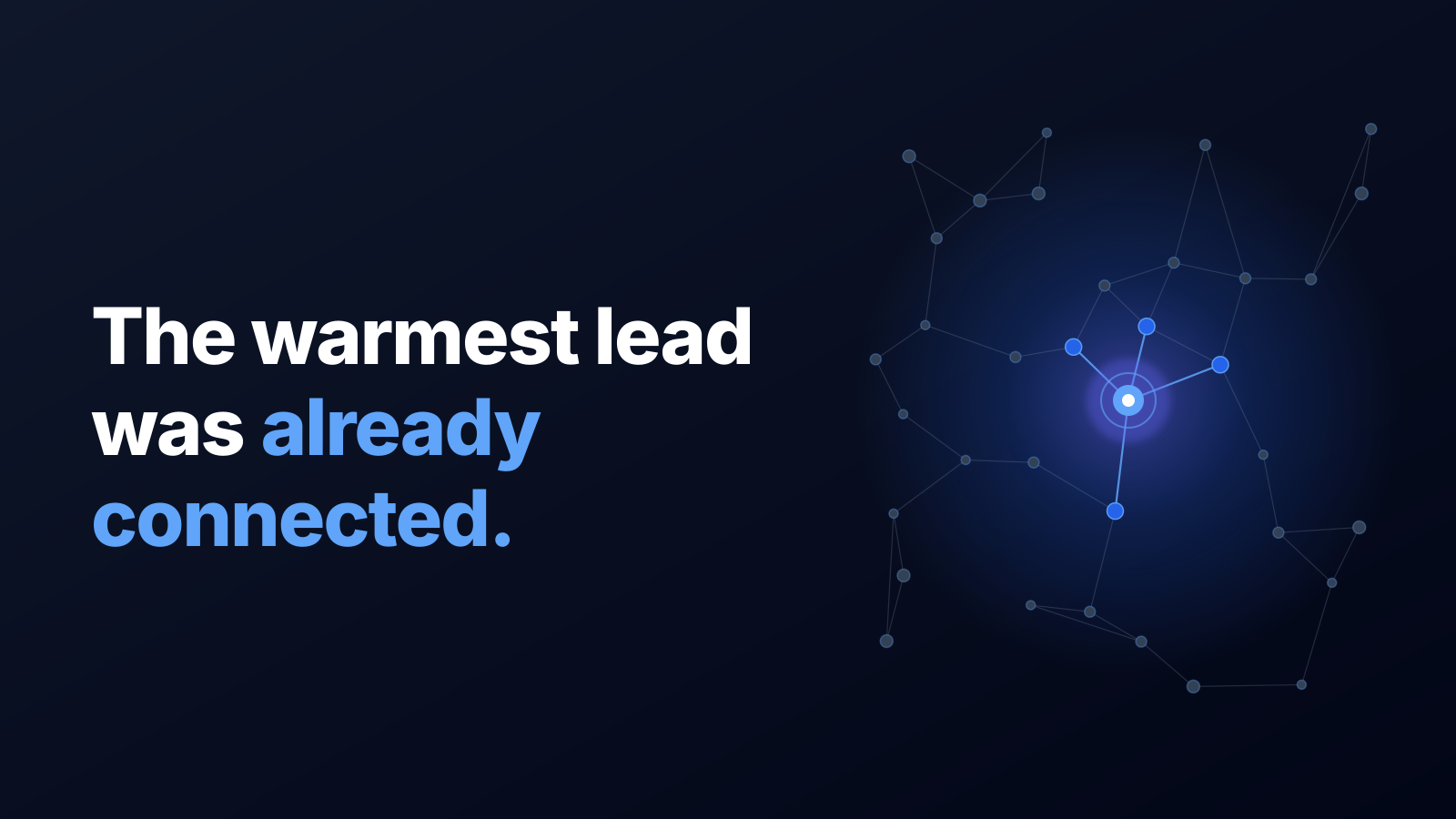
You do not have a lead problem. You have a list problem.
Most outbound teams start the week the same way. Buy a list. Load it into a sequence. Hope a stranger replies to a stranger.
Meanwhile, your LinkedIn already holds hundreds, maybe thousands, of people who know your name. Some did business with you. Some worked beside you. Some accepted your connection request years ago and never heard from you again.
Nobody is looking at them. This post is about why that is the biggest missed opportunity in B2B outreach, and what to do about it this week.
The cold list problem
A bought list gives you names. It does not give you a reason to talk to any of them.
That is the whole problem. Every person on that list is a stranger with no context, so your first message has to do all the work alone. It has to earn attention, build trust, and make an offer in three sentences.
Cold outreach replies at 10% for us. Messages to existing connections reply at 40%. Pull both numbers from your own last 90 days. The gap is usually the first thing people notice.
You also pay for the list. Data credits, sending infrastructure, warm-up time, and the domains you burn when volume gets ahead of quality.
Myth 1: "I need more strangers"
Growth feels like adding new names, so teams keep adding. More lists, more scrapers, more tools.
But a connection is already a small yes. They accepted the request. Some followed you, some commented, some bought from you. That is trust you did not have to pay for.
The truth: the hardest part of outreach is the first yes, and your network already gave it to you.
Try this. Open your connections and sort by the date you connected. Read the first 50 names. How many would you be embarrassed to message? Probably very few. How many are you messaging today? Probably none.
Myth 2: "Old connections are dead weight"
A connection from a few years ago feels expired. Awkward. Stale. Why would they care now?
But dormant is not dead. People change jobs, inherit budgets, and pick up new problems. The connection did not decay. Your context did.
The cost of messaging an old connection is one slightly awkward line. The cost of messaging a stranger is the entire relationship. Pick the cheaper risk.
Myth 3: "I'd know if someone was ready"
You would not. A list of names is flat. It tells you who someone is and nothing about when they are ready to talk.
Timing lives in signals. A new role. A hiring post. A funding announcement. A comment about a problem you solve. Those signals are scattered across thousands of profiles you will never read one by one.
So the people who are ready right now stay invisible, and you message whoever happens to be at the top of the spreadsheet. That is not a strategy. That is alphabetical order.
What a ready connection looks like
A ready connection has a reason to talk that is visible from the outside. These are the signals worth watching:
A new role. New leaders look at their stack and their vendors in the first months.
A hiring push. If they are hiring for the function you support, the problem is live.
A post or comment about your problem. They have said it out loud.
A company milestone. A funding round, launch, or expansion changes priorities.
Engagement with your content. A like, comment, or profile view is a small hand raise.
When you see one, reference the signal, not your product. For example:
Saw you stepped into the [role] at [Company]. Congrats. We worked together on [shared context] a while back. Curious how you're thinking about [problem] in the first few months?
That message works even if they never want what you sell. It reopens a relationship, and the offer can wait for the reply.
How to start this week
You do not need a tool for this. A spreadsheet is enough to prove the idea.
Export your connections. LinkedIn lets you request a copy of your data, and it includes your connections list.
Pick your top 100 by fit. Right role, right company size, and someone who knew you well enough to remember you.
Check each one for a signal. No signal, skip for now. A signal, write one specific message that references it.
Send 10 a day and track replies. After two weeks, compare the reply rate against your cold outreach.
The tool only matters once your network is too big to read by hand. Until then, the habit matters more than the software.
Where Aizyn fits
Reading thousands of profiles by hand does not scale. That is why we built Aizyn.
Aizyn turns your LinkedIn network into sales opportunities. It surfaces the connections worth talking to right now, so you spend your time in conversations instead of scrolling.
If you want to see what is already sitting in your network, book a call and we will look at it together.
Start with a reason.