Why Your CRM Doesn't Tell You Who to Contact Next
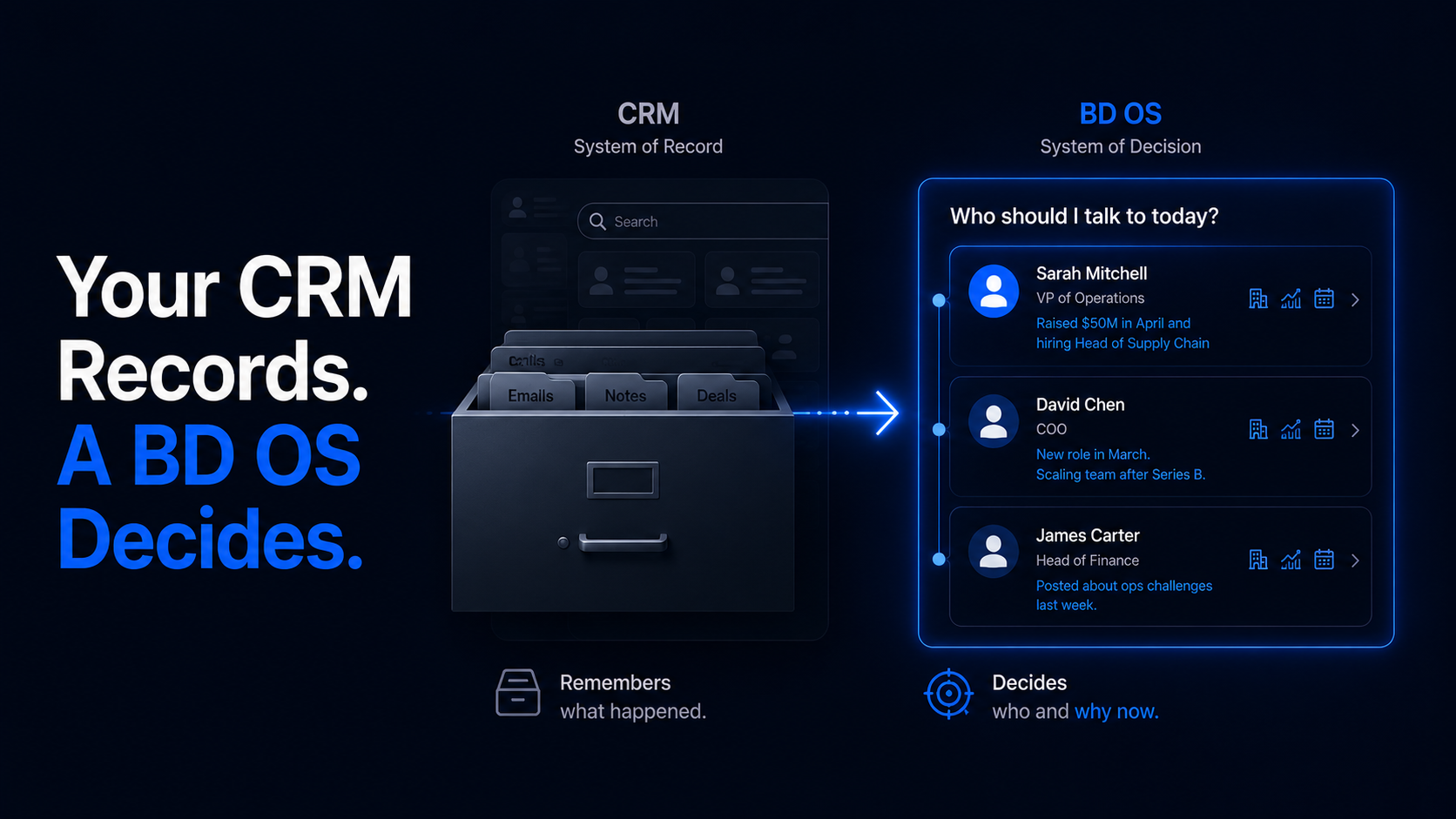
Open your CRM right now and ask it a simple question.
Who should I talk to today?
It cannot answer. Not because your CRM is bad, or badly configured, or missing an integration. It cannot answer because it was never built to.
A CRM is a system of record. Its job is to remember what happened. Who you spoke to, what stage the deal reached, what was said, what closed and what did not. It is a filing cabinet with very good search.
Filing cabinets do not have opinions.
The record and the decision
There are two jobs in business development. The industry has only solved one.
The first is recording. Log the call, update the stage, attach the notes. Every CRM does this competently, and most teams already resent how long it takes.
The second is deciding. Out of the 3,000 people you have some relationship with, which twelve deserve a message this week, and why now?
Deciding is where the money is. It is also the job nobody built software for.
So it falls to the person. Every morning a founder sits down and performs an unaided act of memory and judgment. They scroll a pipeline sorted by close date, which tells them what they hoped would happen rather than what is ready to move. They open LinkedIn and message whoever the feed surfaces. A name comes to mind, it brings a small hit of certainty, and off they go.
That is not a decision. It is a guess dressed up as a routine.
What your CRM is actually missing
The answer to "who next" depends on three things. Your CRM holds one of them.
It holds history. That part is real. It knows you spoke to someone in March 2023 and that they said the timing was wrong.
It does not hold the world. It has no idea they changed companies in April, that their new employer just raised, or that they have spent a month hiring for the exact role that turns your problem into their problem.
And it does not hold judgment. Even with history and signals side by side, something has to weigh them. A funding round at a company outside your ICP is noise. The same round at the company that told you "come back at Series B" is the most important thing that happened to your pipeline this month.
History plus signal plus judgment produces a decision. Your CRM has one of the three and calls itself a platform.
Why more data made it worse
The instinct of the last decade was to add data. Enrichment, intent, contact databases, scoring models.
It helped less than expected, because supply was never the constraint.
Consider the arithmetic. A founder with 4,000 connections wants to know who is worth a message. Properly reviewing one person, recent activity, company news, headcount changes, past threads, takes about eight minutes. Across the full network that is over five hundred hours.
Nobody does five hundred hours. So they sample. They look at the ten names in front of them and choose from those ten.
The quality of your business development is capped by the quality of your sample, not the size of your database. Adding another million contacts to a system that can only surface ten of them changes nothing.
The gap that costs the most
You lose fewer deals to competitors than you do to timing.
A prospect goes quiet. You mark it closed lost. Eleven months later the exact condition that would have made them buy finally arrives. Their ops lead leaves. They raise. They outgrow the workaround they picked over you.
Nothing in your stack notices. The record of the conversation sits in the CRM, complete and accurate and inert. The signal appears on LinkedIn, where you are not looking. The two never meet.
That deal did not die. It expired in storage.
What a Business Development Operating System does instead
Start from the question rather than the record.
If the job is "who deserves my attention today," the software has to do four things, in this order.
Know who you actually know. Not a purchased list. The people you have real history with, including the ones you have forgotten.
Watch what changes. Role moves, funding, hiring, launches, renewed activity after a long silence. The events that turn a maybe into a now.
Apply your definition of fit. A signal only means something relative to who you sell to. Without that filter you have a news feed, not a priority list.
Produce a short list with reasons. Not a score. Names, each with the sentence explaining why today.
That output is the product. Everything else is plumbing.
Notice what this does not claim. It does not predict who will buy. Nobody knows that, and any tool promising otherwise is selling certainty it cannot deliver. It narrows three thousand people to twelve and tells you what changed. You still decide. You still write the message. You still run the conversation.
The gain is not automation. It is attention, pointed at the right place, every morning, without losing the first two hours of the day finding it.
A test you can run tomorrow
Before you open any tool, write down the five people you plan to contact. Next to each one, write the specific reason it is today rather than last month or next quarter.
If you can write the reason for all five, you have a working system, whether it lives in software or in your head.
If you cannot, those names were not chosen. They surfaced.
That is the difference between activity and business development, and it is worth more than any amount of message-writing skill layered on top.