
The Deals You Didn't Lose
Most pipeline doesn't die from competition. It dies from timing, and then it gets filed under "closed lost."
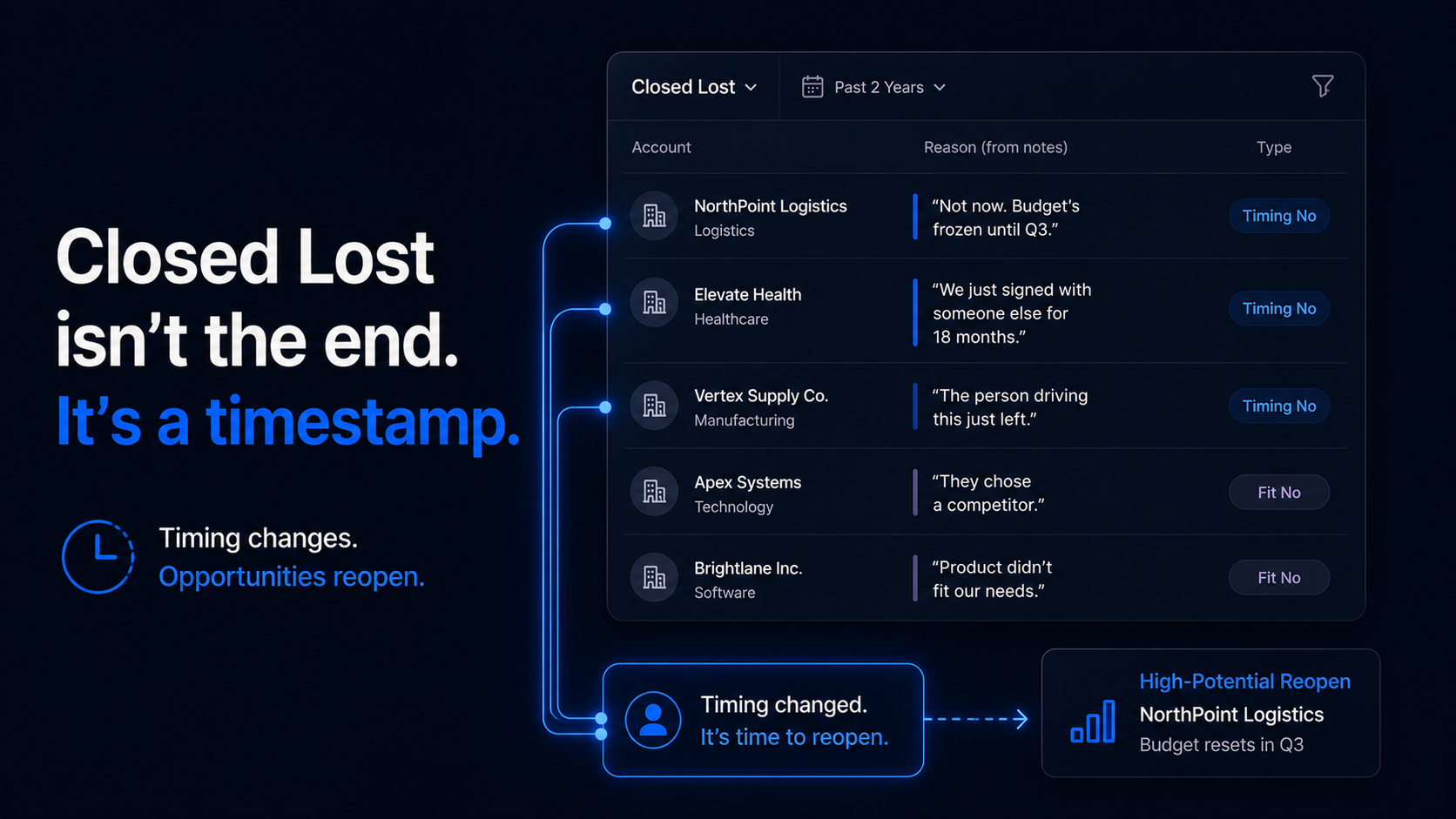
Go into your CRM and filter for closed lost over the past two years.
Now read the reasons. Not the dropdown values, the actual notes.
You will find some real losses. They chose a competitor. The product genuinely didn't fit. Someone made a call you couldn't influence.
But a large share of that list will say something else. Not now. Next year maybe. We just signed with someone else for eighteen months. Budget's frozen until Q3. The person driving this just left.
Those are not losses. They are appointments nobody scheduled.
And they are sitting in the same graveyard as the real ones, which is the actual problem.
Two words that mean completely different things
Every "no" you receive is one of two kinds, and treating them the same is expensive.
A fit no is permanent. They are the wrong size, in the wrong market, with the wrong problem. Nothing that happens next year changes it. This one deserves the graveyard.
A timing no is a snapshot. It describes a moment, not a company. It says that on this particular Tuesday, the budget, the priority, or the person you needed was unavailable.
Every one of those conditions has a shelf life.
Budgets reset. Priorities shift when the CEO changes the plan. Contracts expire. People leave. The workaround they picked instead of you starts breaking at scale.
A fit no is a verdict. A timing no is a timestamp.
Your CRM records both with the same three letters and files them in the same place.
Why the timing deals are the best pipeline you have
Here's the part that gets missed. A timing no is not just salvageable, it is better than most of what your team is currently working.
Think about what already happened in that relationship.
They took the meeting. They understood the problem well enough to evaluate you. Somebody internally did work to get it in front of a decision maker. You know their stack, their objections, their constraints, and often the exact condition that would have made them say yes.
Compare that to a cold prospect, who has done none of it and starts by deciding whether you are worth a reply.
You are not restarting with a timing no. You are resuming.
And the reopener writes itself, because you are not inventing a reason to make contact. The reason already exists and you were told it directly. All you are waiting for is the condition to change.
The four changes that make a no reversible
You do not need to monitor everything. In practice, four events flip the answer, and they are all observable from the outside.
The money changed. They raised, or the fiscal year turned over. "No budget" is the most reversible objection in sales, and it reverses on a schedule you can see.
The people changed. Your champion moved to another company, which gives you a warm door at a new account. Or the person who blocked you left, which removes the reason for the no. Or a new leader arrived with a mandate to fix the exact thing you do.
The pressure changed. They started hiring for roles that only exist when your problem gets serious. They announced expansion into a market that breaks their current setup. They shipped something that multiplies the volume they have to handle.
The silence changed. They started reading your emails again. They looked at your site. They engaged with something you posted after a year of nothing. Someone in there is quietly re-evaluating.
Any one of these turns a closed-lost record into the most qualified conversation available to you this week.
So why doesn't anybody do this?
Not laziness. Arithmetic.
Say you have two hundred closed-lost deals worth revisiting. To check whether any of the four changes has occurred, you have to look at each account, each contact, and each thread, and you have to do it repeatedly, because a signal that hasn't fired yet this month may fire next month.
Call it five minutes per account, checked quarterly. That is over sixty hours a year of pure looking, before a single message gets written.
Nobody has sixty hours for looking. So the list stays closed and the deals expire in storage.
The failure is not judgment. Every rep in your company would know what to do if you handed them the right name at the right moment. The failure is retrieval. The record of the conversation lives in one system, the signal that makes it relevant appears somewhere else entirely, and the two never meet without a human physically going to find them.
That gap is where most of the reopenable pipeline in your business is currently sitting.
How to reopen without sounding like a follow-up
When the moment does arrive, the message is short and it has one job: make it obvious you are not working a list.
The formula is one sentence of specific memory, one sentence of what changed, one low-friction question.
Not this:
Hi Sarah, just circling back to see if anything has changed on your end.
That reads as automated regardless of whether it was, because it contains no information only you could know.
This:
Sarah, when we spoke in early 2024 you said this would be worth revisiting once you were past thirty people and had ops in-house. Saw the two ops hires this month. Worth picking that thread back up?
The second one cannot be sent to anyone else. That is the entire standard.
Notice it never apologizes for the gap, never says "I know it's been a while," and never announces itself as a follow-up. The silence is not the subject. What changed is the subject.
What to do this week
You can start this without buying anything.
Pull your closed-lost list from the last twenty-four months. Sort it into fit nos and timing nos, and delete the fit nos from your thinking permanently.
Take the ten most valuable timing nos. For each, spend two minutes looking for one of the four changes.
You will not find a signal on most of them. That is expected and it is fine.
You will find one on two or three. Those are the best conversations available to you this week, and every one of them was already in your CRM, marked as lost.
Then ask the harder question. That took you twenty minutes and covered ten accounts. What would it be worth to have the other hundred and ninety checked as well, every week, without anybody doing the looking?
That is not a follow-up problem. It is a prioritization problem, and it is the reason most companies keep prospecting for strangers while their best pipeline quietly ages in a folder marked closed.