
Sales Follow-Up Statistics for 2026: What the Data Actually Says
Follow-ups bring in more than half of all replies, yet nearly half of reps never send one. Here are the 2026 numbers worth quoting, and the famous one you should stop using.
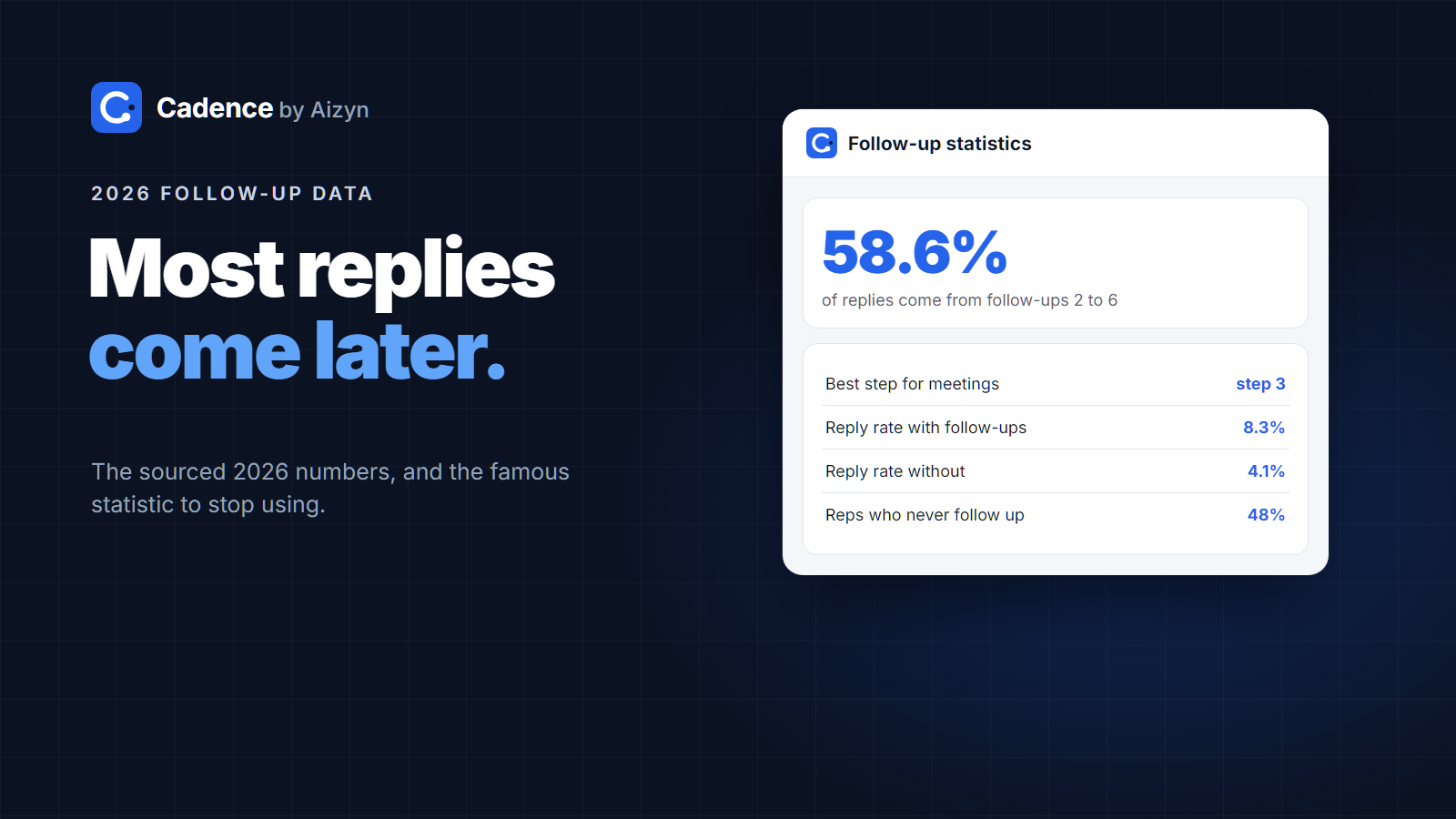
Follow-ups bring in more than half of all replies. In Belkins' 2026 study of 7.5 million B2B emails, steps 2 to 6 of a sequence produced 58.6% of replies, and step 3 booked the most meetings. Woodpecker found that sequences with follow-ups get about twice the reply rate of those without (8.3% vs 4.1%), yet 48% of reps never send one. The popular claim that "80% of sales need five follow-ups" comes from a 1942 survey of fewer than 40 people.
The numbers worth quoting
| Statistic | Source |
|---|---|
| Steps 2 to 6 of a sequence produce 58.6% of replies; the first message produces 41.4% | Belkins, 2026 (7.5M emails sent in 2025) |
| Step 3 books more meetings than steps 1 and 2 combined (35.6% of email-sourced meetings) | Belkins, 2026 |
| The practical sweet spot is 3 to 5 steps; step 6 adds little | Belkins, 2026 |
| Sequences with follow-ups reply at 8.3%, without them at 4.1% | Woodpecker, 2026 |
| 42% of replies come from follow-ups, yet 48% of reps never send one | Woodpecker, 2026 |
What this means
Most replies come after the first message. If you stop after one message, you leave more than half your replies on the table. That is the single clearest finding in the data.
The middle of the sequence does the work. The first message gets the most replies of any single step, but the third step is where meetings get booked. People who reply late are often the ones who were interested but busy.
More is not always better. Reply rates per step fall steadily, and by the sixth step there is little left to gain. Three to five follow-ups, spaced out, is the range the data supports.
The biggest gap is behavior, not technique. Nearly half of reps never follow up at all. Before rewriting your templates, make sure the follow-ups actually get sent.
The statistic to stop using
"80% of sales are made between the fifth and twelfth contact" appears in countless sales decks. It is usually credited to the National Sales Executives Association.
When SMEI, that association's successor, searched its archives, it traced the claim to a 1942 survey of one chapter in Long Island, New York, with fewer than 40 respondents. It may still be directionally true that persistence pays, but it is not a modern benchmark. Use the 2026 numbers above instead.
Does this apply to LinkedIn?
Most published follow-up data comes from email, because email is easier to measure at scale. LinkedIn conversations are more personal and shorter, so treat these numbers as a guide, not a rule.
The patterns carry over well: most replies come after the first message, a few well-spaced follow-ups beat many rushed ones, and the most common failure is simply forgetting. For LinkedIn timing specifically, see how long to wait to follow up on LinkedIn.
Measure your own numbers
Benchmarks tell you what is typical. Your own reply rate tells you what is working for you.
Cadence, a free Chrome extension for LinkedIn follow-ups, reports your messages sent, replies and response rate by day, week, month and year. It logs as you go and never sends anything for you.
FAQ
What percentage of sales replies come from follow-ups?
In Belkins' 2026 study, follow-up steps 2 to 6 produced 58.6% of replies. Woodpecker's 2026 data put it at 42%.
How many follow-ups should you send?
Three to five. Belkins found that the third step books the most meetings and that the sixth step adds little.
Is it true that 80% of sales need five follow-ups?
That figure traces back to a 1942 survey of fewer than 40 people. It is not a reliable modern statistic.
Do follow-ups really increase reply rates?
Yes. Woodpecker found sequences with follow-ups reply at 8.3%, about double the 4.1% of sequences without them.