
Relationship Intelligence: How to Turn Your Existing Network Into Predictable Pipeline
Most B2B teams are focused on finding more leads. But the next opportunity may already be sitting inside your LinkedIn network. Learn how relationship intelligence turns existing connections, timing signals, and professional context into predictable pipeline.
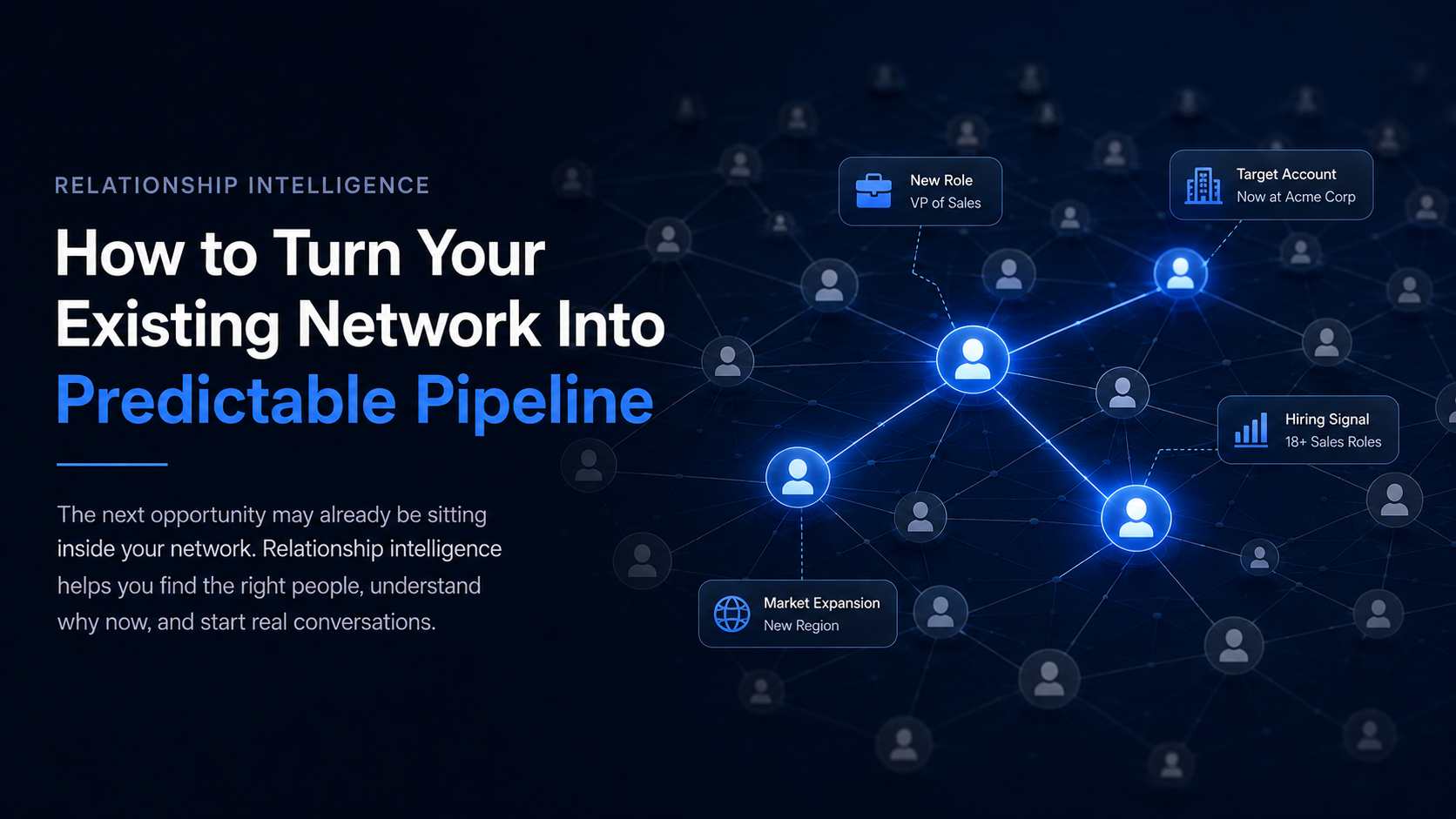
Most B2B sales teams are trying to solve a problem they don't actually have.
They think they need more leads.
So they buy bigger databases, add more prospects to their CRM, connect more inboxes, and send more outbound.
10,000 contacts become 20,000.
500 emails become 2,000.
And when the replies don't come, they increase the volume again.
Meanwhile, there is a massive pool of potential opportunities they already have access to.
It's sitting inside their LinkedIn networks.
Former customers.
Past prospects.
Old colleagues.
Partners.
Industry peers.
People who changed companies.
People who were never ready six months ago but might be now.
The problem isn't finding more people.
It's knowing which people are worth talking to, and why now.
That's where relationship intelligence comes in.
The Problem With Traditional Prospecting
Cold outbound starts from zero.
You don't know the prospect.
They don't know you.
There is no shared history, no established trust, and often no reason for them to pay attention to your message.
So the salesperson has to create all three.
First, establish credibility.
Then establish relevance.
Then create enough interest to earn a response.
And they're trying to do all of this in a few lines of an email or LinkedIn message.
Static ICP filters don't solve this.
Knowing someone is a VP of Sales at a 200-person SaaS company tells you who they are.
It doesn't tell you:
What they're working on right now
What changed inside the business
Whether they have budget
Whether they're actively hiring
Whether their priorities have shifted
Whether they've used your product before
Whether someone on your team already knows them
Whether there's a natural reason to start a conversation
That's the difference between prospecting and relationship intelligence.
Your Network Is Already a Pipeline
Think about the combined LinkedIn networks of your:
Founder
CEO
Sales team
Business development team
Advisors
Executives
Between them, there could be thousands of professional relationships.
But most companies treat those relationships like a database.
They collect them.
They don't activate them.
A connection made three years ago becomes buried underneath hundreds of new connections.
A former customer changes companies.
A previous prospect gets promoted.
An old colleague joins a company that suddenly fits your ICP perfectly.
The opportunity exists.
Nobody notices.
This is the hidden pipeline inside your network.
What Is Relationship Intelligence?
Relationship intelligence is the systematic process of identifying, monitoring, prioritizing, and activating existing professional relationships based on relevance, context, and timing.
Instead of asking:
"Who should we cold email?"
You ask:
"Who do we already know that has a reason to talk to us right now?"
That small change completely changes the outbound strategy.
You're no longer starting every conversation from zero.
You are starting with some level of relationship capital already established.
The challenge becomes finding the right moment to use it.
The Missing Variable Is Timing
Having a relationship isn't enough.
You can know someone for five years and still have no reason to contact them today.
That's why relationship intelligence isn't just about mapping connections.
It's about identifying why-now signals.
A relationship becomes an opportunity when three things line up:
Fit + Relationship + Timing
Someone can be a perfect ICP but have no reason to buy.
Someone can know you well but have no current need.
Someone can have an urgent problem but have no relationship with you.
The strongest opportunities happen when all three overlap.
3 Signals That Can Turn a Relationship Into an Opportunity
1. A Champion Changes Companies
One of the most valuable signals is a former customer, champion, or strong relationship moving into a new role.
You suddenly have a warm relationship inside a new account.
They already understand your value.
They already know what you do.
And they may now have a completely new mandate.
The conversation isn't:
"Hi, I'm selling X."
It's:
"Congrats on the new role. How's the transition going?"
That's a completely different starting point.
The same thing can happen in reverse.
When your contact leaves a company, their old organization may suddenly have a new decision-maker, a new problem, or a need to replace an existing solution.
One job change can create multiple opportunities.
2. Hiring Signals
Hiring is one of the clearest indicators that something is happening inside a company.
A company hiring five salespeople may be scaling revenue.
A company hiring RevOps may be rebuilding its sales infrastructure.
A company hiring engineers may be preparing for a new product or expansion.
A company hiring operations staff may be dealing with increased demand.
When someone in your network works at that company, the signal becomes much more interesting.
You don't need to guess whether something is happening.
The company is telling you.
The question becomes:
"Does this change create a reason for us to reconnect?"
3. Company Changes and Strategic Milestones
Businesses constantly go through transition periods.
Funding.
New leadership.
Product launches.
International expansion.
Acquisitions.
New markets.
Rapid growth.
Major hiring.
These events create windows where companies reconsider their existing tools, vendors, processes, and strategies.
And those windows are especially valuable when you already know someone inside the company.
Instead of reaching out because the account matches your ICP, you reach out because something changed.
That's a much stronger reason to start a conversation.
The Relationship-Led Pipeline Playbook
So how do you actually turn this into a system?
Step 1: Map Your Existing Network
Start with the people you already know.
Look across the networks of:
Founders
Sales leaders
Executives
Account managers
Advisors
Business development teams
Then identify relationships connected to your ICP.
Don't worry about finding the perfect opportunity yet.
First, understand the network you already have.
Step 2: Add Context
A list of names isn't enough.
You need context around each relationship.
Who are they?
Where do they work?
What did you previously talk about?
Have they been a customer?
Were they a prospect?
Are they a partner?
How strong is the relationship?
What has changed since you last spoke?
This is where relationship intelligence starts becoming useful.
Step 3: Monitor for Change
The network shouldn't be treated as a static spreadsheet.
People change jobs.
Companies hire.
Executives get promoted.
Businesses expand.
New initiatives launch.
Markets change.
Those events can turn an ordinary connection into an opportunity.
The goal is to continuously identify these changes and connect them back to the relationships you already have.
Step 4: Prioritize
Not every connection deserves a message.
Prioritize based on:
Fit
Does the company or person match the ICP?
Relationship
How much existing context exists between you?
Timing
Is there a current reason to reconnect?
Signal
What actually changed?
Business relevance
Could that change create a legitimate conversation?
The result should be a small list of high-quality opportunities, not another list of thousands of contacts.
Then Comes the Message
This is where most relationship-led outbound goes wrong.
They identify a warm relationship...
Then send a cold message.
Something like:
"Hey John, hope you're doing well. I wanted to reach out because we help companies like yours increase revenue. Would you be open to a quick 15-minute call?"
You just threw away the advantage of having the relationship.
The message should start with the context.
Not the pitch.
If they changed jobs:
"Saw you made the move to X. Congrats! How's the new role treating you?"
If they posted about a company initiative:
"Saw the announcement about X. Looks like you guys are moving fast."
If they are hiring:
"Saw you're hiring a bunch of SDRs. Scaling the outbound team?"
If you genuinely have a personal connection:
"My wife loves your brand. We actually just bought X."
The point isn't to make the message look personalized.
The point is to have a real reason to send it.
Relationship Intelligence Isn't About Sending More Messages
This is the biggest misconception.
The goal isn't to take your 3,000 LinkedIn connections and message all 3,000.
That's just another version of cold outbound.
The goal is to find the 20–50 people who actually have a reason to hear from you.
Then have better conversations with them.
That changes the economics of outbound.
Instead of:
More contacts → More messages → More noise
You get:
Better relationships → Better signals → Better timing → Better conversations
From Lead Generation to Opportunity Discovery
Traditional outbound asks:
Who can we sell to?
Relationship intelligence asks:
Who do we already know that might need us now?
That's a fundamentally different approach.
Your LinkedIn network isn't just a collection of contacts.
It's a collection of relationship capital.
But relationship capital only becomes valuable when you know where to apply it.
The opportunity isn't necessarily hiding in another database.
It may already be sitting in your network.
You just need the visibility and context to find it.
The Future of B2B Outbound Is Not More Volume
Cold outbound isn't going away.
But the idea that pipeline can be solved by continuously increasing message volume is becoming harder to defend.
The next generation of business development will be more selective.
More contextual.
More relationship-driven.
More signal-driven.
The best sales teams won't necessarily be the ones sending the most messages.
They'll be the ones who know:
Who to contact.
Why to contact them.
Why now.
And what to say.
That's the promise of relationship intelligence.
You don't need more people to contact.
You need to get better at recognizing the opportunities already inside the relationships you've built.