
Business Development Is a System. Most Companies Run It as a Personality Trait.
If your pipeline depends on one person remembering the right names, you don't have a process. You have a rainmaker.
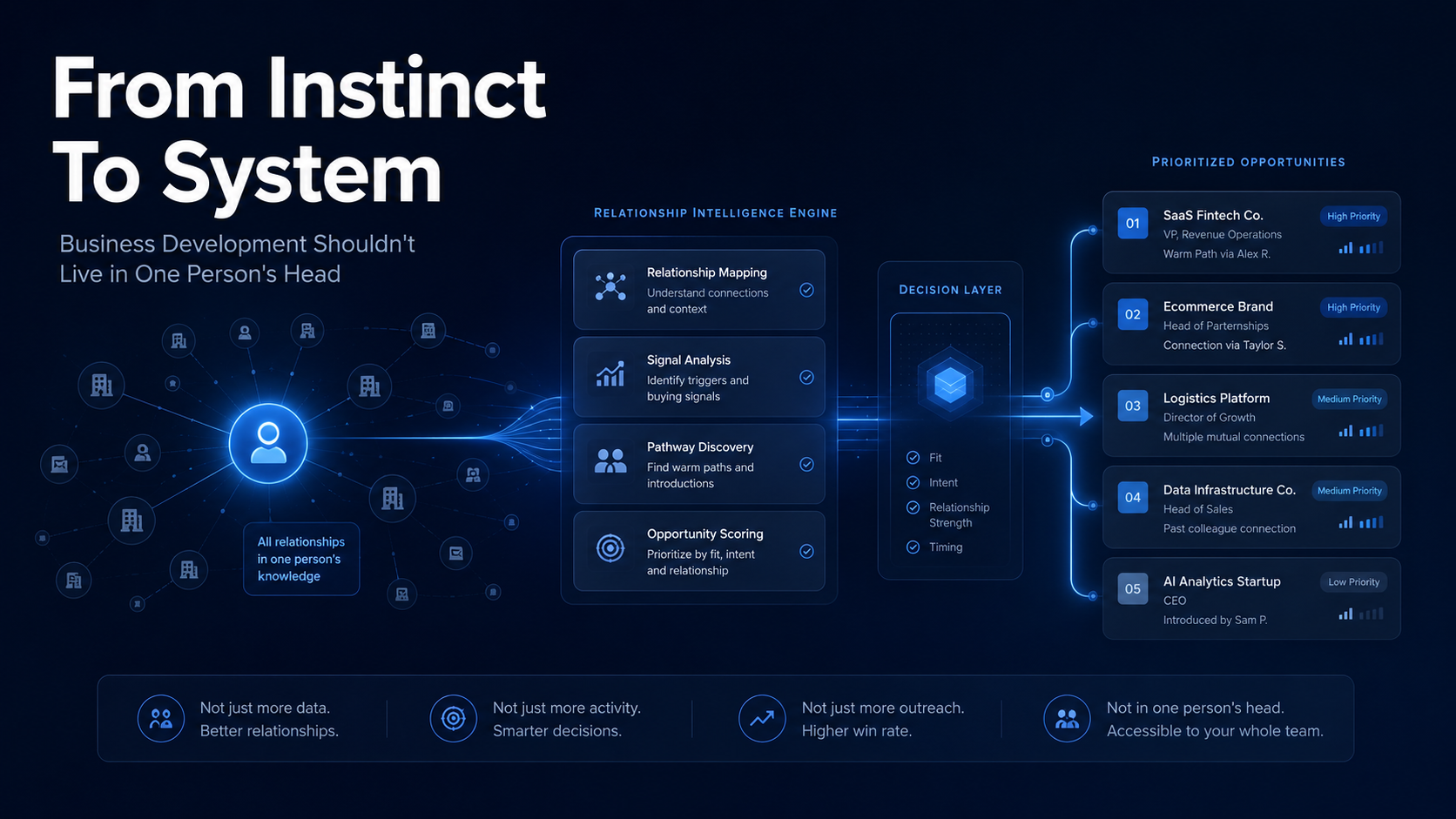
In most companies, the best business development lives in one or two people's heads.
It's usually a founder, or an early salesperson who has been there long enough to know everyone. They have a feel for who to call. They remember that a customer from three years ago moved to a company that would be perfect now. They just know.
And because they know, nobody ever writes it down.
This works right up until it doesn't. The person leaves, or gets too busy, or tries to hire under them, and the new person has none of the instinct and none of the memory. Pipeline that looked like a capability turns out to have been a single point of failure the whole time.
That is the quiet problem underneath a lot of growth that stalls. The business development was never a system. It was a talent, and talent doesn't transfer.
The tell
There's a fast way to know which one you have.
Ask the person who drives your pipeline why they contacted the five people they contacted this week. Then ask if a new hire, given the same accounts, would have arrived at the same five.
If the answer is no, you don't have a process. You have a habit of remembering, running inside one person's head, invisible to everyone else and impossible to teach.
A real system produces the same quality of decision no matter who is sitting in the chair or how their morning went. That is the whole definition. Not more effort, not more names. Consistency of judgment, made repeatable.
Why we tolerate it
We tolerate it because we've mythologized the rainmaker.
Sales culture loves the person with the golden gut, the operator who can walk into any room and leave with a deal. So when pipeline depends on one person's instinct, we don't see a risk. We see a star.
But instinct is just pattern recognition that never got written down. The rainmaker isn't doing magic. They're running a process they've never made explicit: they notice when someone in their network changes jobs, they remember who said "not now" and why, they feel when a relationship has become relevant again.
All of that can be described. And anything that can be described can be turned into a system that more than one person can run.
What a system actually is
A business development system is not a script, and it is not a sequence tool. Those govern execution, the sending part, which was never the hard part.
The system is the layer before execution: the repeatable way you answer three questions every morning.
Who, out of everyone we already know, is worth attention today. Why this week and not last month or next quarter. And what to open the conversation with so it lands.
Answer those three the same way every day, for every person on the team, and you have a system. The messages that follow are just output. Get the three questions right and mediocre execution still works. Get them wrong and the best copywriting in the world is aimed at the wrong people.
Why your CRM isn't the system
The natural objection is that this already exists. It's the CRM.
It isn't. A CRM is a system of record. It remembers what happened: the calls, the stages, the notes. It's a filing cabinet with good search, and filing cabinets don't have opinions about what you should do next.
The same is true of a spreadsheet of target accounts, which is where most teams keep their "system." A list of names is not a process. It tells you who you decided to care about at the moment you built the list. It says nothing about which of them became relevant this week, and it goes stale the day after you make it.
Storing information and deciding what to do with it are different jobs. Every tool in the stack does the first one. Almost nothing does the second, so the second falls back to the person with the instinct, and we're back where we started.
What changes when it becomes a system
Turn business development from a trait into a process and several things stop being fragile at once.
Onboarding changes. A new rep can be productive in weeks instead of the year it takes to build a feel, because the judgment lives in the system rather than in their tenure.
Consistency changes. The team's output no longer swings with who is motivated this week. The floor comes up.
Forecasting changes. Pipeline built by a repeatable process is a pipeline you can actually reason about, because it wasn't assembled from one person's mood and memory.
And the obvious one: it survives people leaving. The relationships stay an asset of the company instead of walking out the door with whoever happened to remember them.
How to start this week
You don't need to buy anything to test whether you have a system.
Write down how you actually decide who to contact. Not the aspirational version, the real one. If the honest answer is "I go with what feels relevant," that's your finding. The process is in your head, and only you can run it.
Then make one piece of it explicit. Pick the single strongest reason you ever reach back out to someone, a job change, a funding round, a returning customer, and commit to checking for that one trigger across your accounts every week, on a schedule, written down.
That is one line of a system where there was none. It's teachable, it's repeatable, and it doesn't depend on you being the one who remembers.
The goal is not to remove judgment. It's to stop keeping all of it in one person's head. Business development is too important to run on memory and mood, and it's too repeatable to have to.
The companies that figure this out stop asking who their best rainmaker is. They build a system that makes the whole team decide like one.